As a continuation of the innovative practices of assessing students for their understanding of the content that is taught at school, student presentations were organized. Students of all classes made presentations on various subjects. A presentation is an open space for students to speak and listen to themselves as they speak. The participation of every student is ensured. It provides an environment where people can have a debate. So the knowledge of every topic is enhanced as so many questions come out, an answer must be found.
For example when the Pre Bridge Class was studying Russian Revolution they studied that Lenin was one of actors in the Russian Revolution and that Marx influenced him. But they soon came to a point where they needed to know what influenced Marx. This even the teacher did not know. But she found out and answered their question. Thus using different resources and inquiry as a method both students and teachers learn to learn.
Showing posts with label Project Based Inquiry Learning. Show all posts
Showing posts with label Project Based Inquiry Learning. Show all posts


Workshop on Sexuality
The Hope Project School has seen as many attempts at introducing sexuality in the curriculum as it has seen movements of determined resistance to it. The staff was introduced to excellent curricula, even trained on transacting it, but nothing seemed to pass the test of subtle and undefined appropriateness that was the thin red line. Like so many other ideas that were picked through and discarded, because of an inarticulated code of right and wrong, acceptable and unacceptable, this section of possible curriculum remained at arms length. Any attempt to put the code into words by the teachers was poetic, seemingly over-emotional and frustrating for all concerned, so that the mentors, management and the teachers awkwardly avoided the issue of implementation by slipping into familiar opposite corners where each felt they were not understood. While the adults debated or avoided debate on content, methodology and context, any sessions taken with children were absorbed quickly with great enthusiasm, adding fuel to arguments by each side.
The solution that has been implemented and worked for two terms now, is neither unheralded nor brilliant in its innovation. It is different from what was done in earlier years only in that the teacher is in charge of the content. All materials available on the subject are available and well used as resource materials from which she has culled out a curriculum.
The main focus of the curriculum has shifted from the content that has to be shared to being the shifts in the awareness that the children are able to articulate. By the use of Critical Pedagogy almost a month’s time is used to generate an atmosphere of confidence and trust within the small group of students, so that the possibility of sharing reality as it is viewed by them is created. The weight of the content shared is then absorbed by the class as it begins to function as a support group. The teacher becomes the primary resource who introduces other materials as resources on demand.
The content aspect of the curriculum then emerges as a result of this interaction. It is paced by the students, as it is a response to the curiosity and inquiry of the children on the subject. The teacher does a mapping of the curriculum that emerges to the standards available at the end of each session. In the two workshops that have been taken thus far, children have exceeded expectations of content as laid down in the standard material for adolescent health and well being.
The solution that has been implemented and worked for two terms now, is neither unheralded nor brilliant in its innovation. It is different from what was done in earlier years only in that the teacher is in charge of the content. All materials available on the subject are available and well used as resource materials from which she has culled out a curriculum.
The main focus of the curriculum has shifted from the content that has to be shared to being the shifts in the awareness that the children are able to articulate. By the use of Critical Pedagogy almost a month’s time is used to generate an atmosphere of confidence and trust within the small group of students, so that the possibility of sharing reality as it is viewed by them is created. The weight of the content shared is then absorbed by the class as it begins to function as a support group. The teacher becomes the primary resource who introduces other materials as resources on demand.
The content aspect of the curriculum then emerges as a result of this interaction. It is paced by the students, as it is a response to the curiosity and inquiry of the children on the subject. The teacher does a mapping of the curriculum that emerges to the standards available at the end of each session. In the two workshops that have been taken thus far, children have exceeded expectations of content as laid down in the standard material for adolescent health and well being.
Home Science Exhibition 2005-6
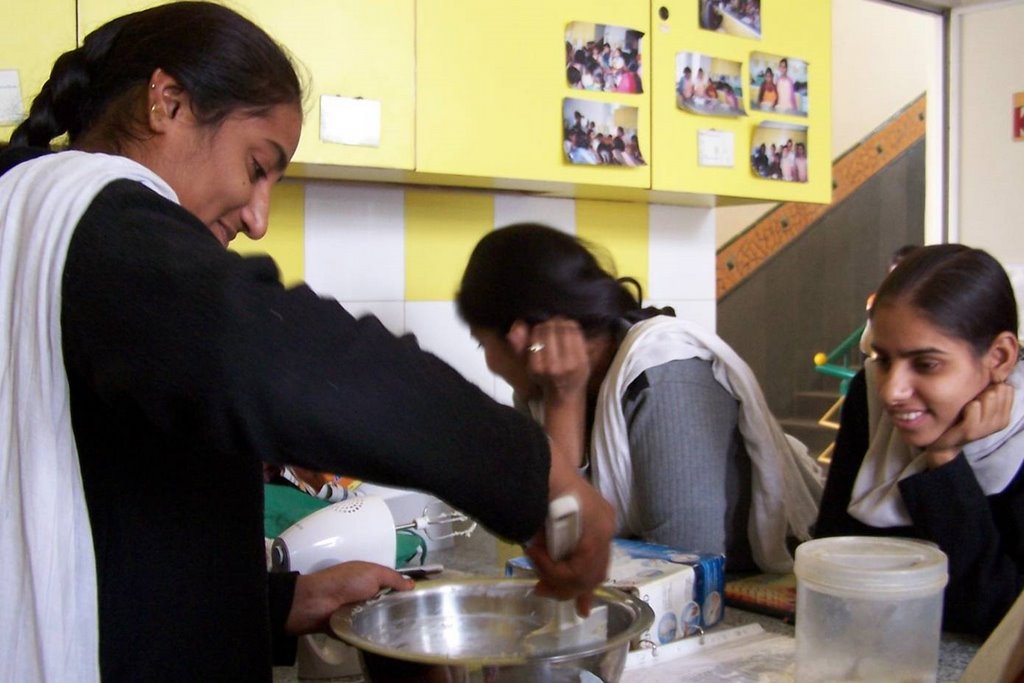
The Home Science Lab had its first exhibition. On show were students’ learning about cooking, food preservation, textiles, and catering, nutrition and consumer education.
The students of the Home Science classes made pickles, ‘paushtik parathas’, and ‘dum chai’ & sold the combination for Rs.10/- on the day of the Home Science Exhibition.
The pickles were sold out @ Rs.45/- per Kg on the same day among the staff.
The pickles are a non-labour intensive income-generating activity that can be begun. Bottles need to be collected in which to sell the pickle.
The students of the Home Science classes made pickles, ‘paushtik parathas’, and ‘dum chai’ & sold the combination for Rs.10/- on the day of the Home Science Exhibition.
The pickles were sold out @ Rs.45/- per Kg on the same day among the staff.
The pickles are a non-labour intensive income-generating activity that can be begun. Bottles need to be collected in which to sell the pickle.
Science Exhibition 2005-6
One of the ways in which students are assessed at Hope is through their ability to convey their understanding about a subject to the uninitiated. We invited guests to provide them and our students the opportunity to assess and celebrate their learning in Science. There was a marked difference in the nature of the exhibition this year as compared to last year. This year, the focus shifted from the aesthetics of the presentation to ensuring learning and comprehension. The number of models and the drama of the perfectly decorated charts were replaced by pristine functional diagrams, teaching aids, digital learning resources, driving questions, practical examples and lengthy engaging conversations.
World Literacy Day Celebrations - September 11, 2006
Project Duration: 8 August - 11 Spetember

The initiative was taken by Room to Read to celebrate World Literacy Day as it is celebrated internationally on the 8th of September, 2006 . It was celebrated on the 10 th due to schedule constraints of the donor agency, along with another NGO, Manzil, because of constraints they had.
Children follow up on an activity that had taken place in their Bal Panchayat in May, in which they identified children who lived on their street, who were out of school. During the follow up, they concentrated on their own families. They investigated, then, reported the number of members in their household and the literacy levels of each member. The follow up was done at the class level during Rishtaa periods.
The senior computer literate students enter this information into the computer using the Excel program.
Children are introduced to the World Literacy Day and the opportunity they have to contribute to this effort in the Bal Panchayat. The previous follow up exercise was put into perspective.
In another Bal Panchayat, the students analyze the community in 5 households including theirs, the literacy levels of all members therein and the reasons why those not engaged in an education are unwilling or do not have access to education.
As part of the above Bal Panchayat, the students decide that a small population of children keep away from education because they do not know all the fun it entails. Thus, they decide to invite as many of this population living in their 5 household catchment area that each child has been allotted to a World Literacy Day Celebration.
On Saturday the 2nd of September, the Bal Panchayat meets to discuss the arrangements and entertainment for their guests, to discuss solutions for the other groups with different problems that have emerged from the data and its analysis.
On Monday the 11th of September, the children meet to take a pledge that they will take on the education of one other person who has little or no education until they learn at least up to the class 5 (CBSC) level.
The guest of honor will be the Principal of the local Government Primary School at Katra. 
The Blog Project, 17th August - 4th September, 2006
Three volunteers from France, who have been friends to the Project for two years, came back to run a project with community children, through which they created a blog about the ‘basti’. Participants went through a long and trying selection process. Only those found committed and clear about the contribution they expected to make were invited to join the 12 day workshop. Students were taught the basics of digital photography, interviewing techniques, researching and writing an article in collaboration with the computer and language experts of the school.
The blog was launched on the 5th of September and is available for comment in Hindi and in English at this address: http://nizamuddinbastiblog.freeflux.net
While creating a ‘basti’ blog was the idea of the volunteers, it was taken up with a lot of enthusiasm by Kamini who was very impressed by the impact that a blog could make when it focussed on an issue that needed to be discussed at the community level. Her reference was the Nanglamachi movement against inhumane demolitions and the blog that popularised the issue and gained the protestors a lot of support. Shariq, the community worker at Hope who has had a great deal of experience working with the ‘basti’ youth on various issues of conscientization, as well as with media, was also very excited with the potential for the blog being a medium of expression for the ‘basti’ at large. The concerns were about the fact that relatively speaking very few people in the ‘basti’ are computer literate. The project went ahead inspite of this concern because there was a dependable hope that this situation had the potential to change. The students of the school would all contribute and the blog would be introduced in cybercafes across the ‘basti’ and candle-to-candle the word and activity on the blog would spread.
The blog was launched on the 5th of September and is available for comment in Hindi and in English at this address: http://nizamuddinbastiblog.freeflux.net
While creating a ‘basti’ blog was the idea of the volunteers, it was taken up with a lot of enthusiasm by Kamini who was very impressed by the impact that a blog could make when it focussed on an issue that needed to be discussed at the community level. Her reference was the Nanglamachi movement against inhumane demolitions and the blog that popularised the issue and gained the protestors a lot of support. Shariq, the community worker at Hope who has had a great deal of experience working with the ‘basti’ youth on various issues of conscientization, as well as with media, was also very excited with the potential for the blog being a medium of expression for the ‘basti’ at large. The concerns were about the fact that relatively speaking very few people in the ‘basti’ are computer literate. The project went ahead inspite of this concern because there was a dependable hope that this situation had the potential to change. The students of the school would all contribute and the blog would be introduced in cybercafes across the ‘basti’ and candle-to-candle the word and activity on the blog would spread.
Desert Eco Region - August 18-25, 2006
The trip to Rajasthan was planned as part of the Social Science and General Sciences curriculum. The Social Sciences curriculum is based on the belief that geography leads to history leads to culture. Thus, the course content begins with the story of the universe and the earth, forces of nature and different eco regions on the planet, followed by how life emerged and adapted to the differences in habitat.
To supplement the instruction in the classroom, the students of the Girls Non Formal School are taken on study tours to various habitats. They visited the alpine habitat in the last academic year and this August they have visited the desert eco region. In December they hope to visit the marine habitat in Tamil Nadu. The trip was the first time that the staff planned a trip independently with decreased support from the Education Advisor. 20 girls took the trip accompanied by the Social Science and Science expert.
The children prepared for the trip by studying reviewing the basic concepts about the echonograph and habitats before the trip. The teachers were briefed and researched the NGO that would host them in one location and all the others they would visit on their tour. The excitement and trials of the selection procedure took its toll on the time and energy of the staff that mentored the children, but the values taught and learnt are integral to the curriculum[1] implemented by the project.
Similarly, the flash floods in Rajasthan while the trip was in progress forced the group to make many decisions about changes in plan which contributed to learning. An exhibition will be held in September by the participants to share their learning. This will be supported by an exhibition of the research done on the Jodhpur region by the students who did not travel.
[1] The teaching team at the Project wrote a list of values and ideals that they wish their students to graduate with. We call this the Critical Curriculum.
To supplement the instruction in the classroom, the students of the Girls Non Formal School are taken on study tours to various habitats. They visited the alpine habitat in the last academic year and this August they have visited the desert eco region. In December they hope to visit the marine habitat in Tamil Nadu. The trip was the first time that the staff planned a trip independently with decreased support from the Education Advisor. 20 girls took the trip accompanied by the Social Science and Science expert.
The children prepared for the trip by studying reviewing the basic concepts about the echonograph and habitats before the trip. The teachers were briefed and researched the NGO that would host them in one location and all the others they would visit on their tour. The excitement and trials of the selection procedure took its toll on the time and energy of the staff that mentored the children, but the values taught and learnt are integral to the curriculum[1] implemented by the project.
Similarly, the flash floods in Rajasthan while the trip was in progress forced the group to make many decisions about changes in plan which contributed to learning. An exhibition will be held in September by the participants to share their learning. This will be supported by an exhibition of the research done on the Jodhpur region by the students who did not travel.
[1] The teaching team at the Project wrote a list of values and ideals that they wish their students to graduate with. We call this the Critical Curriculum.
Email Exchange Project
Language Learning is a difficult business without it involving a third and fourth language.
The email exchange project has been an activity that the school has tried to work on in fits and starts for more than a year without much success or consistency. Setting up and maintaining an exchange with another school/ class in another location can be a logistical nightmare, especially as, conventionally, it involves scanning students’ work, taking and sending digital images and a matching of schedules. Given the nascent computer skills of the teachers and students at present, the focus of the project then gets diverted toward logistics and coordination rather than language learning. Thus, it has now been decided that the email exchange board will become an extension of the Student’s Parliament.
The board will become one more avenue of exchange between the students and teachers or management. Students’ questions received in the letter box will be answered here. The minutes of the Bal Panchayat meetings will be posted here. Interesting news and urgent announcements concerning students will be posted here. It will be like a wall newspaper, in terms of content so that the interest in reading it is kept alive in the students. Meanwhile, teachers’ skills are being developed further so that an inter-cultural exchange project can begin very soon.
The email exchange project has been an activity that the school has tried to work on in fits and starts for more than a year without much success or consistency. Setting up and maintaining an exchange with another school/ class in another location can be a logistical nightmare, especially as, conventionally, it involves scanning students’ work, taking and sending digital images and a matching of schedules. Given the nascent computer skills of the teachers and students at present, the focus of the project then gets diverted toward logistics and coordination rather than language learning. Thus, it has now been decided that the email exchange board will become an extension of the Student’s Parliament.
The board will become one more avenue of exchange between the students and teachers or management. Students’ questions received in the letter box will be answered here. The minutes of the Bal Panchayat meetings will be posted here. Interesting news and urgent announcements concerning students will be posted here. It will be like a wall newspaper, in terms of content so that the interest in reading it is kept alive in the students. Meanwhile, teachers’ skills are being developed further so that an inter-cultural exchange project can begin very soon.
Subscribe to:
Posts (Atom)